Nokia Lumia photography chief Ari Partinen joins Apple
Apple's mobile imaging team looks to have a new leader, as former Nokia camera engineering executive Ari Partinen announced on Friday that he will depart the Finnish smartphone maker and move to its American rival.
Partinen made the announcement on Twitter, saying that Friday was his last day at Nokia and that he would soon "start a new chapter in Cupertino, California." The tweets were first noticed by Engadget.
According to his LinkedIn profile, Partinen leaves Nokia as the company's Lumia Photography Lead "in the fields of mobile photography, image quality verification, verification up-streaming, 3rd party management and collaboration, supplier collaboration and technical marketing in various multimedia segments." Products for which he was responsible include the Nokia 808 PureView and Nokia N8.
A graduate of Helsinki University of Technology, Partinen joined Nokia as an image quality engineer in 2007. He is credited as one of the inventors of Nokia's PureView system, which is widely lauded by photography enthusiasts as among the best mobile camera technologies available.
PureView uses pixel oversampling and on-chip image processing to shrink a very large image — the Nokia Lumia 1020 ships with a 41-megapixel camera — into a smaller, higher-quality one. This allows for sharper images, enhanced digital zoom capability, and better low-light performance.
Apple rumored to launch 4.7-inch 'iPhone 6' in August, larger model in September
According to the latest rumblings out of the Far East, Apple is planning to debut the 4.7-inch version of its next-generation iPhone in August and may follow up with a larger model a month later.
Mockup of iPhone with 4.94-inch screen, created by Marco Arment.
Reuters on Friday pointed to a report from Taiwan's Economic Daily News that cited unnamed sources in Apple's supply chain as saying the hotly anticipated "iPhone 6" could be unveiled in August, one month earlier than the company's usual product cycle.
Light on details, the Taiwanese publication claims Apple will release the 4.7-inch version of its flagship handset before a larger 5.5-inch or 5.6-inch model debuts in September. Rumors of a 5.6-inch iPhone has been tossed out before — most recently in February by the same newspaper — though prevailing speculation points to a 5.5-inch screen size.
While initial market availability is unknown, sources expect Apple's partner suppliers to produce a total of 80 million iPhone 6 models by the end of 2014.
Friday's rumor adds to the near daily stream of supposed parts leaks, mockups and inside information regarding Apple's next iPhone. On Thursday, it was reported that Pegatron will be responsible for 15 percent of all 4.7-inch iPhone 6 orders, a change from Apple's usual reliance on Foxconn to build its premium tier handsets.
For 2014, Apple is widely expected to debut two new top-end iPhones with larger screens that appeal to a wider swath of consumers. Until today, most reports speculated that the smaller version of Apple's iPhone 6 would launch in September, while the larger iteration would see release months later due to issues related to display and battery yields.
Discover the latest offers and experience the best in digital entertainment from Sony. Get hot new content, including the latest movies, music and games, straight from your Xperia smartphone or tablet.
Take a look below to see what’s in it for you.
Check back soon for exclusive offers
Although there are no Sony Mobile entertainment offers in your region at the moment, we are working on getting some exclusive deals. So check back soon, for new offers as they become available.
Our smartphones and tablets run on the world’s most popular platform for mobile devices.
The Sony and Android symbiosis has been formed to give you spine-tingling entertainment and smooth performance.
Let us introduce Android
Android is what you want it to be. This open-source software from Google™ lets you tailor your device to suit your needs. Android comes complete with Google Play™, a new digital content experience where you can find your favourite music, films, TV shows, books and over 1 million Android apps and games. Seamless multi-tasking, widgets to customise your home screen and great ease-of-use – it’s all available on Android smartphones and tablets from Sony. More about Android
Sony on top
If it ain’t broke, don’t fix it. That’s an approach most of us would probably agree with. So, with the Android operating system offering such smooth operation, we don’t cram a lot of unnecessary stuff onto our devices.
Therefore, the Android operating system installed on our Xperia smartphones and tablets is cleaner than most.
The functions and apps that we do include add true value – distinct and unique Sony flavours of beautiful design, intuitive user interface and craftsmanship.
On your home screen
The Sony layer starts directly on your home screen. That’s where you’ll find our media applications:
Album application
All your photos and videos in one place, with new ways to sort, explore and view on your vividly crisp Xperia screen.
WALKMAN application
The best of Sony audio technologies let you easily share and listen to online music and your own tracks.
Movies application
Enjoy playback perfection and seamless access to your own videos, Hollywood blockbusters and TV programmes.
Find your way. Find your mates. Or simply find some fun. Work or play, rain or shine, Xperia Android smartphones and tablets come preloaded with all of the Google services that you need to make your device truly yours.
The WALKMAN, Movies and Album apps let you dive into a world of entertainment. View, listen to and enjoy your stored stuff in the same view as online content. Discover new bands and films that you didn’t know existed. Share it all with friends.
To get your all-access pass to the hottest titles – millions of songs, the latest blockbusters and more – check out the Sony Entertainment Network*. One account and one log-in are all you need to get your hands on a huge library of digital entertainment.
The WALKMAN app – all your music in one place
Enjoy your music in soul-shaking clarity. The WALKMAN app is powered by ClearAudio+ and lets you activate the best Sony audio technologies in just one click. You access all of your online and offline tracks in one place. And with Facebook seamlessly integrated, it’s easy to share your great taste in music and discover what favourite tracks your friends are enjoying.
Online services like Music Unlimited* are the perfect way to discover new music. Music Unlimited brings you millions and millions of songs – from worldwide chart-toppers to indie gems. Enjoy Music Unlimited on your Xperia smartphone or tablet, PlayStation®3, PSP® (PlayStation®Portable), BRAVIA® TV, PCs and other Android tablets.
The Movies app – the best viewing experience
Immersive sound and vision and an amazing viewing experience – say hello to Sony’s Movies app. Watch films at any time, anywhere, and get information on directors, actors and films with just one click.
The Movies app gives you easy access to your stored videos. And with a Video Unlimited** account, you can buy or rent films straight from your Xperia device. Choose from a wide selection of Hollywood blockbusters, all-time classics and TV programmes.
** Watch films and TV programmes on your Xperia™ smartphone or Xperia™ tablet; BRAVIA® televisions; Blu-ray Disc™ home cinema systems; Windows-based PCs through Media Go; Blu-ray Disc™ players; Sony Internet TV powered by Google TV; PlayStation®3 systems, PlayStation®VITA, PSP® (PlayStation®Portable) systems, through the PlayStation®Store.
The Album app – your photos and videos at any time, anywhere
Crisp, sharp and colourful – bring out the best in your photos and videos with the Album app. All your stored and online pics are available from the same place, with new ways to sort and explore. And the Album app also makes it easy to share memories with friends and family.
With PlayMemories Online integrated, you can upload and access your photos and videos from multiple devices. Instantly, easily – and syncing happens automatically.
Immerse yourself in a world of gaming with PlayStation®Mobile
Enjoy PlayStation® – like gaming on your Xperia device. Explore a wide range of titles from a variety of new and established game developers. Buy each game just once and play it across your PlayStation™-certified devices, including PS Vita.
Download new games in minutes directly from the PlayStation®Store.
Sony Select
Games, applications, music and video – all the best for you. The Sony Select service selects only the best applications and services, and you can access them easily. Moreover, Sony Select shows you only those applications and services that are guaranteed to work on your Xperia device.
Samsung Galaxy S4 vs Galaxy S III: Advanced fence-sitting
Introduction
Upgrader's dilemmas. We've had a few of those over the years but, every once in a while, deciding between the next generation and the last transcends the limits of a brand. By consistently delivering the goods, the Galaxy line has become synonymous with the best that Android has to offer. Now, it's a huge reputation to live up to and it's only getting harder for every new flagship.
With millions of Galaxy S4's being packaged as we speak and prepared for shipping, it's the time for hard choices. Very much so for Galaxy S III owners - about 50 million of them on latest account. Upgrade or stay put? Tough one.
Or is it? For smartphone geeks it borders on a no-brainer. It's the newer model that flaunts a full-HD five-incher and an immensely powerful chipset, with a 13MP camera and a host new software tricks to boot. Those should be enough of a nudge to get fence-sitters on the right side of the fence. Which, from Samsung's perspective, is the side of the Galaxy S4.
That's the thing, though. It's the manufacturer's job to always get people interested in the latest. You on the other hand, want to know if they're getting enough in return for their hard-earned cash. You may still end up buying a new model every year, but it should be a choice not a compulsion.
Samsung Galaxy S4 over Samsung Galaxy S III
5" 1920 x 1080 Super AMOLED display with ~441 ppi density, Gorilla Glass 3 (over 4.8" 720p ~306 ppi on the S III)
Quad-core Snapdragon 600 or Exynos 5 Octa chipset
2 GB of RAM on all models (only the US LTE-capable S III has 2 GB RAM)
13 MP camera (8 MP on the S III)
2 MP 1080p front-facer (1.9 MP 720p on the S III)
Temperature and humidity sensors
Wireless charging
Air gestures, smart gestures (some may eventually come to the S III)
Wi-Fi ac, faster HSDPA (42.2 Mbps over 21 Mbps on the S III)
LTE on all models
More compact, thinner and slightly lighter body (7.9 mm vs 8.6 mm, 130 g vs 133 g)
Higher-capacity battery (2600 vs 2100 mAh)
Samsung Galaxy S III over Samsung Galaxy S4
Cheaper
FM radio
Will eventually receive most of the TouchWiz novelties via update
Wider field of view in camera and camcorder
Samsung did its best - again - to make it easy for users to choose the Galaxy S4. No dramatic changes to the styling might be a concern, but then again it's obvious that a lot of effort went into the design. The Galaxy S4 packs a bigger battery, a slightly larger screen, a more powerful processor into a body that's more compact than that of its predecessor.
The screen is a significant step up from the previous model too - it's crisper, having more than double the amount of pixels, superior brightness and colors and, not least of all, does have that precious extra room for even better productivity and multimedia experience.
On the software front, there are air gestures, eye tracking, face tracking, Smart Pause. Features that elevate the TouchWiz experience above the rest in terms of both usability and novelty, but at least some of them will eventually land on the Galaxy S III too.
So, while it's clear that the Galaxy S4 is in many ways superior to the Galaxy S III, it's equally easy to turn that around and say that both phones share many similarities. Both will be running the latest Android software when the Galaxy S III gets its promised update and both have great Super AMOLED screens, capable processors, expandable storage, solid battery life and stellar cameras. Both phones at HQ
There a significant price gap between the two as well and that's another important part of the decision-making. So, while it's not impossible to put a price on improvements like to the screen, camera, processing power, audio quality and the like, the hard bit is for every user to do their own math and decide whether the premium charged is worth it. We'll try to cover every important aspect of the experience these two can provide and hopefully get most of your questions answered. We're back after the break with the design and build overview
in your view which is best give your comments :
Asus Fonepad 7 Dual SIM is powered by Intel Atom Z2520 mobile chipset and Android 4.3 Jelly Bean operating system.
Related Stories
Lava E-Tab Ivory dual SIM tablet launched at Rs 10,199
Dual-SIM MTV Slash 4X tablet launched for Rs 9,999
iBall Slide 3G 7271-HD70 with Dual-SIM support launched for Rs 8299
iBall 3G 7271 HD7 tablet with dual SIM support launched for Rs 8,399
Asus is set to introduce yet another affordable tablet with voice calling support for the lucrative budget segment of India. The company has sent invites to media groups for an event on April 15 to launch the new tablet, called Asus Fonepad 7.
Asus already offers two variants of the same tablet in India but this one has two SIM slots. However, there is no word on the 4G LTE network supporting Asus Fonepad 7 tablet.
Asus Fonepad 7 Dual SIM model features a 7-inch LED Backlit IPS panel based display with 1280x800 pixel resolution. This display can support up to 10 fingers for multi-touch. This tablet is powered by a dual-core 1.2 GHz Intel Atom Z2520 processor paired with PowerVR SGX544 GPU graphics. It has 1 GB RAM and 8 GB on-board storage. There is a memory slot in the tablet as well which can accomodate a micro SD card of up to 64 GB capacity. By default, the tablet comes loaded with Android 4.3 Jelly Bean update.
The tablet has a 5 megapixel camera at the back and a 1.2 megapixel front camera for video calling. The tablet is meant to be used in portrait mode. Faster mobile internet can be enjoyed with the WiFisupport and the 3G network support in one of the two SIM slots. Other than that the tablet has Bluetooth 3.0 and GPS. ASUS has packed 3950 mAh battery in it which claims to provide about 28 hours of talk time on 3G network.
So far, Indian markets already carry dual-SIM offering tablets that includeMicromax Funbook Mini 410i, iBall Slide 3G 7271-HD70, MTV Slash 4X and Lava E-Tab Ivory to name a few.
Closely priced devices to have a sword fight for style against overall performance.
Related Stories
HTC Desire 500 vs Sony Xperia C
Once again, Samsung has come out with a 'Grand' series smartphone, named as Samsung Galaxy Grand Z. The phone is available now for Rs 17,990 (though Samsung has not formally announced its launch). We thus thought it apt to compare the newborn with the HTC Desire 500 which has been there in the market for quite a while and is currently selling for around the same price.
Display
The Samsung Galaxy Grand Z measures 143.5 x 76.9 x 9.6 mm (height, width, thickness) and weighs 162 grams while the Desire 500 measures 131.8 x 66.9 x 9.9 mm and weighs 123 grams. But before you jump to conclusion, note that the Grand Z has a 5 inch display while the Desire 500 has a smaller 4.3 inch touchscreen and hence the difference in their size and weight.
Displays of both the phones have the same 480x800 pixels resolution but since the Desire 500 has a smaller 4.3 inch display, its screen thus have higher pixel density and so may produce better picture quality than the Grand Z.
Design and look wise too, the Desire 500 may appeal to you bbetter than the Galaxy Grand Z. To start with, the HTC handset has a beautiful colour combination; for instance, the white variant has a red stripe around its edges, another white variant come with a blue strip etc. A speaker mesh above the display also improves its overall look.
The Grand Z looks no different from older Samsung devices which is infact major grudge of people against Samsung. Latest Samsung devices have the faux-leather panel but strangely, the Grand Z has a plain back panel. Battery and Memory
The HTC Desire 500 has a slightly smaller 1800 mAh Li-Po battery as compared to the 2100 mAh battery of Grand Z. But owing to its smaller display, the HTC Desire 500 offers better back up. To be specific, Desire 500 claims to offer 12.1 hours of 3G talktime and 435 hours of 3G standby while Samsung Galaxy Grand Z promises 10 hours of talktime and 440 hours of standby over 3G networks.
Both the phones come with an expandable storage slot that can handle a micro SD card of up to 64 GB capacity but Grand Z's 8 GB internal capacity gives it a bit of edge over the Desire 500 which has only 4 GB ROM.
Samsung Galaxy S5 review: Better, but not the great
Credit: Michael Homnick
It feels like only yesterday that I was unboxing the Galaxy S4. I was impressed with the device, but as the year wore on I was exhausted by Samsung's habit of churning out similar-looking phones stuffed with a few new, mostly underwhelming features.
And yet, here we are with the Galaxy S5. It's the same rounded flat plastic rectangle with a heaping of new-and-improved features, as well as more megapixels to help it compete against other companies vying for the title of "best camera phone."
But to be fair, Samsung pulled back on the reins this time around. It shifted its focus to refining the features that were already present in its predecessors rather than stuffing more into an increasingly wider polymer body. Of course, there was still some of that. Samsung still has a ways to go before it relieves itself of that reputation.
A design that works
It's barely distinguishable from its predecessor. I'm of the unpopular opinion that the plastic builds on Samsung's flagship devices don't actually detract from their premium look and feel. Samsung can fake it really well, even if the phone is physically more prone to cracks and scratches. Michael Homnick Not as thin as you thought. It's a phone that appeals to the masses, both young and old. Our pearly white review unit is particularly attractive with its perforated, subtly iridescent back side, its rounded edges, and its triple-layer trim. And yes, while the HTC One (M8) has more premium feeling, some people may not prefer to have a phone entirely made of metal. Michael Homnick The white looks nice, even if you're having a heated phone call. Then again, who makes phone calls anymore?
The Galaxy S5 is just a bit wider than its predecessor and the dimpled backing has a bit of grip to it so it won't slip out of your hand. There's also a handy one-handed mode that shrinks the interface down a bit, though it’s a bit tricky to bring up with the necessary one-thumb-across-the-screen swipe. Michael Homnick Last year's (right) and this year's (left) Galaxy flagship devices.
Annoyingly, a lone tinny speaker still resides on the backside, which won't bode well if you're watching a YouTube video with a friend or have the phone propped up against something. Or if you want to lay the phone on the table for a speakerphone call. Michael Homnick Don't bet on this phone doubling as your boom box. Samsung still utilizes a backwards button setup: menu button on the far left, and back button on the right. At least the menu button now lets you switch between applications instead of popping up settings, but I'd actually prefer to give up a bit of screen space for Android's conventional on-screen button placement. Also, the Galaxy S5's navigational buttons are way too sensitive to even the slightest brush of flesh; I kept accidentally hitting them while using the phone.
Like most of Samsung's mobile devices, you can remove the back cover to reveal the SIM and microSD slots, as well as the removable battery. There's also a thin rubber lining to help ward off against water and dust. Its Micro-USB 3.0 charging port also features a door to help keep water out, and it doesn't awkwardly stick out like the Xperia Z1S's protective flaps. Michael Homnick It's not that hard to make a flap that isn't awkward.
A slightly brighter Super AMOLED
Michael Homnick Scandal looks simply scandalous on the GS5's Super AMOLED display.
The Galaxy S5 features a 5.1-inch 1080p Full HD Super AMOLED display. Samsung touts the display's ability to better adapt to any type of ambient environment, and the screen can go really dim, thus making it easier on the eyes at night. At its highest brightness, however, it's still an exceedingly bright display with lots of contrast.
It also maintains color accuracy at extreme viewing angles, and its ever-so-slightly wider display makes for an enjoyable video viewing experience on the train ride home. Of course, when the sun shines brightly through the window on the train, you'll have some trouble seeing the screen.
Honestly fast
Initial benchmarks peg the Galaxy S5 as one extremely speedy device. It's the second phone out on the market to feature a Qualcomm Snapdragon 801 system-on-chip (SoC), and it narrowly beat out the HTC One (M8) in Anandtech's benchmark charts. You'll feel a big difference over last year's model even when just scrolling through the TouchWiz UI, which seems to have dialed down the bloat since its last iteration. Just a bit faster.
Last year, Samsung was under fire for tweaking its firmware so that it would score higher on benchmarks. Signs point to this no longer being the case, which is a slight breath of relief. If performance is your main concern, you'll be delighted to know that the Galaxy S5’s 2.5GHz quad-core processor and 2GB of RAM were capable of quickly multitasking between games like Prince of Persia: Sands of Time, Google Play movie rentals, and open pages in the Chrome browser. A word of caution, however: the Galaxy S5 gets seriously caliente when you've got the screen brightness turned up on a video or game.
Battery life for days
If you need a phone to last you through the day and then some, the Galaxy S5 can certainly deliver. Its 2,800mAh battery pack lasted a whopping 10 hours and 45 minutes in our video playback tests with the brightness at 100 lumens and Airplane Mode turned on. It beat out the HTC One (M8) by 45 minutes—about 7.5% longer. If you're traveling on a long-haul flight, it'll be great to have this device on hand.
Its battery life is impressive on standby, too. It only burned through 6 percent of its battery life overnight, and the phone charges rapidly—about 10 percent every 20 minutes, even through a regular USB plug. There are also two power-saving modes: the first blocks background data and restricts performance after the device drops below 20 percent, while Ultra power saving mode saves battery power by reverting to a simplified grayscale interface that only lets you use the most essential phone functions.
Go ahead, leave the point-and-shoot at home
Michael Homnick Trust the GS5; it can take your photos for you just fine. The 16-megapixel rear-facing camera sensor is the best camera Samsung has ever packed with a flagship device. Rather than solely rely on software to fuse together photos, Samsung implemented its new sensor technology called ISOCELL to help improve sharpness and low-light accuracy. But, it’s still the same f/2.2 aperture lens as its older sibling, the only difference being that it now has a 4.8mm focal length and a slightly larger sensor.
Microsoft Windows Phone 8.1 review: Major upgrade closes the gap with iOS and Android
From the bold vibrancy of its new Start screen, to its new digital assistant, Cortana, Microsoft’s new Windows Phone 8.1 establishes itself as a top-tier smartphone platform.
And that’s critical—especially for an operating system currently holding a market share of less than 4 percent among U.S. smartphone buyers (though to be fair, it’s more popular elsewhere). That’s not to say it leaps ahead of Apple’s iOS or Google’s Android, but neither is it markedly deficient in any one area—although it could always use more, higher-quality apps.
What’s even better? You don’t need to twiddle your thumbs, waiting for your carrier to push Windows Phone 8.1 to your phone months down the road. You can sign up for Windows Phone Preview for Developers—yes, you, a mere consumer—and receive the same bits as the carriers receive, as well as any updates. (Note, however, that you may void your warranty, and you may not receive device-specific drivers right away.)
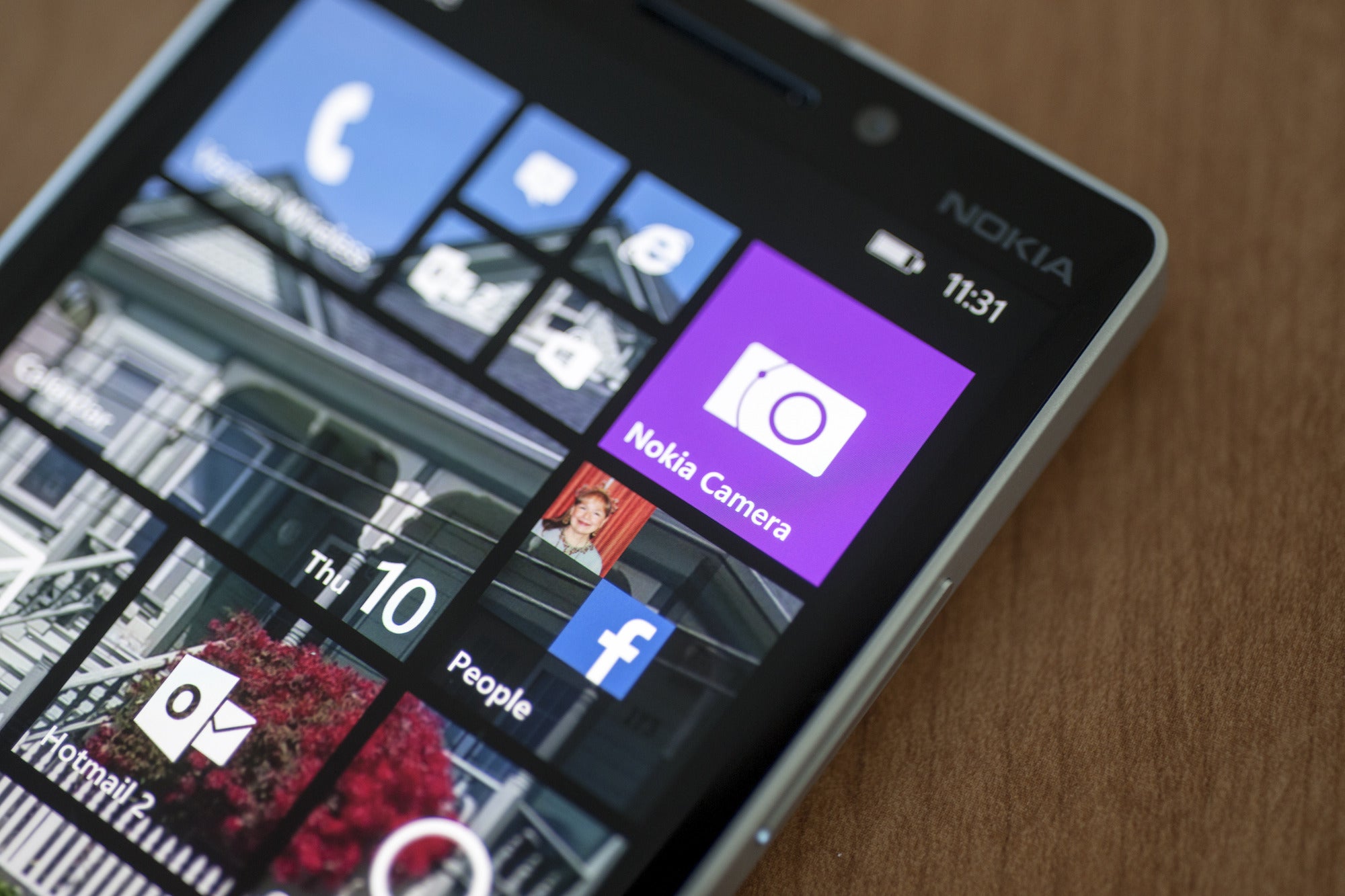
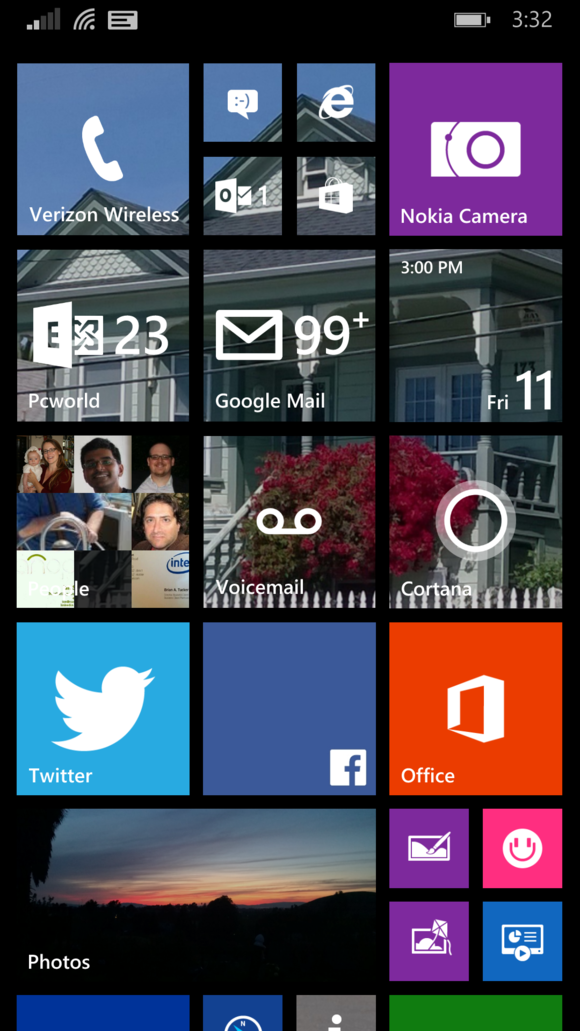
For those less adventurous, Windows Phone 8.1 will be available to all Windows Phone 8 devices, including the Nokia Lumia line. But you’ll likely have to wait a month or two for your carrier to vet the new, free update. Image: Michael HomnickYou can choose a photo to be the focal point of the Windows Phone 8.1 main screen. A random scattering of transparent and opaque Live Tiles overlays the photo, in a way that will seem personalized to some, maybe slightly manic to others.
Windows Phone 8.1 gets personal
Windows Phone 8.1 wants to be your personal operating system. Live Tiles will peek through a screen background of your choosing. The new Cortana digital assistant adjusts itself to your needs and priorities, even screening your calls. And when something of import crops up, a notifications pull-down screen summarizes what you need to know. That barely scratches the surface of the upgrade, but the sum of all the parts is this: a palpable warmth about Windows Phone 8.1 that truly sets it apart. The Windows Phone Start experience just keeps getting better and better. If there was any knock on the Windows Phone 8 Start screen, it might have been that it was too electric. Every Live Tile was brightly colored, many with embedded information scrolling through. There was no obvious focal point.
In all fairness, some of those problems still remain. But my god, the upgrade’s beautiful. And personalized.
On iOS 7, the home screen is a matrix of flat icons. Microsoft redesigned its Windows Phone 8.1 Live Tiles so that on the Start screen, some would be transparent windows overlaid on a background image of your choosing. You can place a People tile that rolls through photos of your contacts. You can set another tile to flash photos from your Camera Roll. You can pin music, specific people, and even websites to the Start screen, all of which can serve updates.
Some might say it gives the Start screen more of a manic look and feel, but the personal touches make the difference. The Start screen could be just a sterile assembly of code and silicon, but instead, it’s a vibrant, incredibly welcoming front door.
On my Nokia Lumia Icon test unit, supplied by Microsoft, Windows Phone 8.1 allows three columns of large Live Tiles. If there’s any criticism to be made here, it’s that the opacity of the tiles themselves is arbitrary—I couldn’t find a way to enable or customize them.


 Michael Homnick
  Michael Homnick
  Michael Homnick
  Michael Homnick
  Michael Homnick
  Michael Homnick

 Michael Homnick